
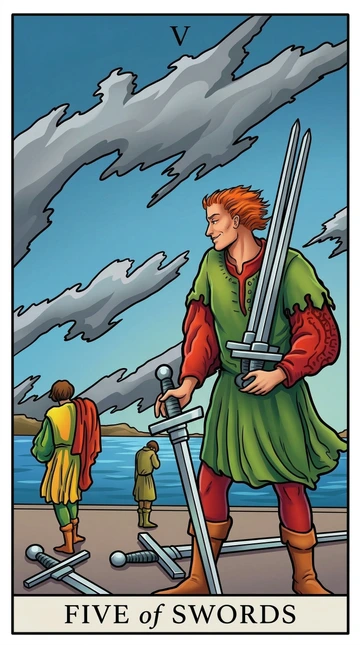
What Five of Swords signals in this area
The Five of Swords, when drawn in relation to career and ambition, often points to a situation of unresolved conflict or a sense of being defeated. This isn't necessarily about a major public failure, but more commonly an internal or interpersonal struggle within a professional setting. It can signify an atmosphere of tension, where competition has turned unhealthy, or where someone has achieved a 'victory' at the expense of others, leading to widespread resentment or a damaged team dynamic.
This card might highlight a project where the initial vision has been compromised due to disagreements, leaving a bitter taste. It could also suggest a feeling of professional alienation, where your ideas or contributions are consistently overlooked or undermined. For those seeking professional growth, the Five of Swords can indicate an environment where progress is stalled by petty arguments or a lack of cooperation. In creative projects, it might signal disputes over ownership, direction, or authorship, leading to a breakdown in collaborative spirit. Finding purpose can feel elusive when this card appears, as it suggests that current professional battles are draining energy and focus from your true calling.
When Five of Swords appears reversed
A reversed Five of Swords in a career context often suggests a turning point or a re-evaluation of past conflicts. It might indicate that you are ready to move on from a period of tension, or that the dust is beginning to settle after a professional dispute. This reversal can signal a desire to mend fences, to make amends, or to find a way to forgive and forget past grievances.
Sometimes, it can represent a realisation that a 'win' wasn't truly a win, and a subsequent attempt to rectify the situation or restore balance. For those experiencing ongoing professional hostility, the reversed Five of Swords might suggest that a resolution is finally within reach, or that you are finding the courage to walk away from an untenable situation. It can also point to a refusal to engage in further conflict, choosing instead to preserve your energy and focus on more constructive endeavours, even if it means acknowledging a past defeat.
Questions to ask yourself
- Where might unresolved conflict be hindering your professional progress?
- Are you holding onto a past professional 'defeat' that needs to be released?
- What battles are truly worth fighting in your current role or project?