
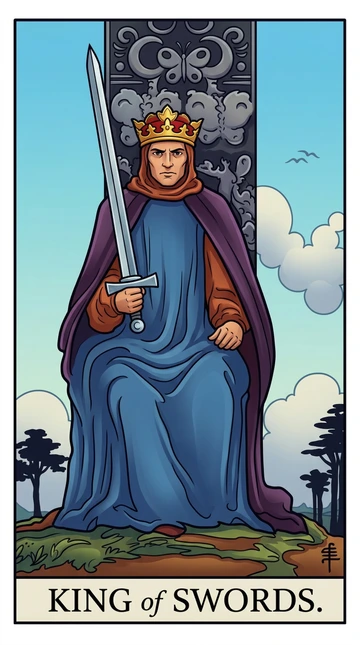
What King of Swords signals in this area
The King of Swords, in a career and ambition context, points towards a need for clear, logical thinking and objective decision-making. It suggests a time to approach professional challenges with a keen intellect and a commitment to truth. This card often appears when a situation requires you to cut through emotional bias or office politics to get to the core facts.
It can signify a period where you need to assert your intellectual authority or take on a leadership role that demands impartiality and sound judgment. For professional growth, it encourages developing expertise, particularly in areas requiring analysis, strategy, or communication of complex ideas. It’s about mastering your field through rigorous thought and precise execution.
When considering creative projects, the King of Swords advises a structured, disciplined approach. While creativity is vital, this card reminds you to apply intellectual rigour to your ideas, ensuring they are well-researched, coherent, and effectively communicated. Finding purpose might involve identifying a career path where your analytical skills and commitment to honesty can make a significant impact.
When King of Swords appears reversed
A reversed King of Swords in career matters can indicate a misuse of intellect or a failure to apply objective reasoning. This might manifest as intellectual arrogance, where one believes their ideas are superior without proper justification, or as a tendency to be overly critical and inflexible. It could also signal a lack of clarity in thinking, leading to poor decisions or a struggle to articulate one's professional vision.
Sometimes, the reversed King of Swords suggests a leader who is tyrannical, unfair, or uses their authority to manipulate rather than guide. It might point to an environment where truth is suppressed, or where logical arguments are dismissed in favour of emotional pleas or personal agendas. For creative projects, it could mean overthinking to the point of stagnation, or an inability to move past initial analytical stages to actual creation. It warns against intellectual paralysis.
Questions to ask yourself
- Am I approaching this professional situation with logic and objectivity?
- Where do I need to apply more intellectual rigour in my work?
- Am I using my authority or knowledge fairly and effectively?