
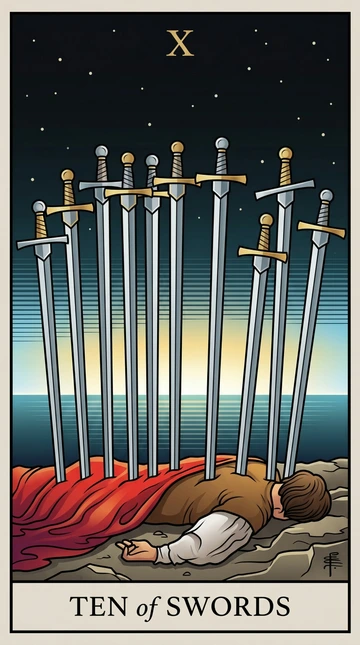
What Ten of Swords signals in this area
The Ten of Swords, when appearing in a reading about career and ambition, often points to a definitive end or a necessary conclusion. This isn't usually a subtle shift but a clear, sometimes painful, finality in a professional situation. It might signal the end of a job, a project, a specific role, or even a long-held career path that is no longer viable.
This card suggests reaching a point of no return, where a situation has become unsustainable or completely exhausted. It can indicate a feeling of defeat, burnout, or being pushed to your absolute limit within your professional environment. While the imagery might seem bleak, the Ten of Swords ultimately represents the completion of a difficult cycle, paving the way for something new. It's about acknowledging a loss or a failure in order to move forward, rather than clinging to a situation that is already beyond salvage.
For creative projects, it could mean abandoning a concept that isn't working, or the painful closure of a project that has run its course. For finding purpose, it might indicate that a particular pursuit or definition of purpose has reached its end, necessitating a re-evaluation of what truly motivates you.
When Ten of Swords appears reversed
A reversed Ten of Swords in a career context can suggest a resistance to letting go of a dying situation. There might be a lingering attachment to a job, project, or ambition that is clearly past its prime, causing prolonged suffering. It could indicate a fear of the inevitable ending, leading to a refusal to accept the reality of a professional situation.
Sometimes, the reversed card signals a gradual recovery from a significant professional setback, or the slow process of rebuilding after a major career upheaval. It might suggest that the worst is over, but the road to recovery is still ongoing and requires patience. In other instances, it could highlight a delayed or incomplete ending, where a painful situation continues to drag on due to an inability to make a decisive cut.
Questions to ask yourself
- What professional situation needs a definitive end?
- Am I resisting a necessary closure in my career or projects?
- What can be learned from past professional setbacks?