
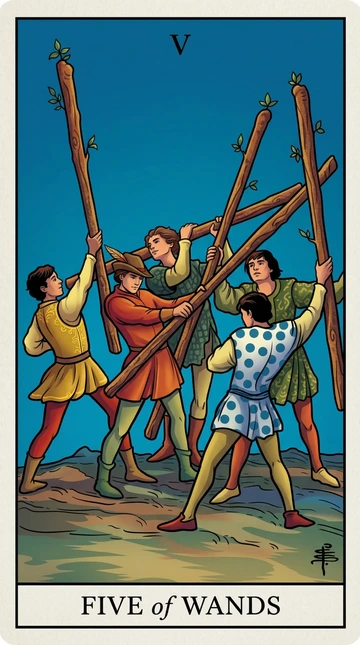
What Five of Wands signals in this area
The Five of Wands in a career and ambition reading often indicates a period of dynamic interaction, which can manifest as competition, internal team disagreements, or a clash of ideas. It points to an environment where multiple voices are vying for attention or where different approaches are being debated. This card suggests a need to navigate various perspectives and potentially challenging personalities within a professional setting.
For professional growth or creative projects, the Five of Wands might highlight a stage where initial ideas are being tested and refined through energetic debate. It is not necessarily a negative card, but rather a signal that resolution will require effort and open communication. Ambition might be met with resistance or a need to prove oneself amongst peers. Finding purpose could feel a little muddled as different paths or philosophies present themselves, creating a sense of internal or external contention.
When Five of Wands appears reversed
When the Five of Wands appears reversed in a career context, it can suggest a retreat from conflict or an inability to resolve ongoing disputes. This might manifest as suppressed disagreements, a lack of healthy competition, or an avoidance of necessary discussions. It could also point to a situation where a past conflict remains unresolved, hindering progress or fostering resentment.
Alternatively, the reversed Five of Wands might indicate that a period of intense competition is drawing to a close, or that a chaotic situation is beginning to find some order. It could also suggest a more internal struggle with ambition or purpose, where one is at odds with their own desires or professional path, without external expression.
Questions to ask yourself
The Five of Wands invites reflection on how one engages with professional challenges and differing viewpoints. It encourages an assessment of communication styles and conflict resolution strategies. This card prompts consideration of whether current professional interactions are constructive or merely chaotic.
It also asks about the nature of competition in one’s work life. Is it motivating and fair, or is it leading to unnecessary tension and obstruction? For those pursuing creative projects, it prompts a look at how feedback is received and integrated.
- Where are the main points of contention in my professional life?
- Am I contributing constructively to current discussions, or avoiding them?
- How can I best navigate differing opinions to achieve my goals?