Understanding Reversed Cards in Tarot
What Does "Reversed" Actually Mean?
A reversed card is simply one that appears upside down when drawn. It happens naturally when your deck is shuffled and some cards rotate. But what it means is where many readers get confused.
The most common misconception is that a reversed card is the "opposite" of its upright meaning. This is an oversimplification that leads to stiff, unhelpful readings. The Empress reversed does not mean barrenness any more than The Sun reversed means darkness.
Reversals are better understood as modifiers. They adjust the energy of a card rather than flipping it on its head. Think of them as a dial being turned down, redirected, or temporarily stuck - not switched off entirely.
Common Ways to Read Reversals
There is no single correct method. Most experienced readers draw from several approaches depending on the card, the question, and the context. Here are the most widely used frameworks.
Blocked or Delayed Energy
The card's upright energy is present but struggling to express itself fully. Something is in the way - an internal fear, an external obstacle, or simply bad timing.
- ✱The Chariot reversed: The drive and determination are there, but progress feels stalled. Something is preventing forward movement.
- ✱The Ace of Cups reversed: Emotional new beginnings are possible, but you may be resisting vulnerability or the timing is not quite right.
Internalised Energy
The card's energy is turned inward rather than expressed outwardly. This is particularly useful for cards that typically describe external events or actions.
- ✱The Emperor reversed: Rather than exerting authority over others, this may point to a need for self-discipline or internal structure.
- ✱The Three of Pentacles reversed: Instead of external collaboration, this could suggest working through something privately or refining your skills before sharing them.
Excess or Deficiency
The card's energy is present but out of balance - either too much or too little. Context usually makes it clear which direction the imbalance leans.
- ✱The Four of Swords reversed: Too little rest (pushing through when you need to pause) or excessive withdrawal (using rest as avoidance).
- ✱Strength reversed: Either overpowering others with force, or lacking the inner resolve a situation demands.
The Shadow Side
Every card has a lighter and a darker expression. A reversal can point towards the card's less constructive manifestation - not its opposite, but its shadow.
- ✱The High Priestess reversed: Instead of deep intuition, this may suggest secrets, denial, or disconnection from inner knowing.
- ✱The Six of Cups reversed: Rather than healthy nostalgia, this could indicate being stuck in the past or idealising what was.
Reading With vs Without Reversals
This is one of the most debated questions in tarot, and the honest answer is that both approaches are entirely valid.
The Case for Reversals
- ✱Greater nuance. Reversals effectively double your interpretive vocabulary. Instead of 78 possible meanings, you have 156.
- ✱Subtlety in readings. They allow cards to express a spectrum of energy rather than a single fixed meaning.
- ✱Natural indicators. A reversed card draws your attention differently. It can signal where extra thought or care is needed.
The Case Against Reversals
- ✱Complexity for beginners. Learning 78 upright meanings is challenging enough. Adding reversals can overwhelm new readers and slow down the learning process.
- ✱Positional nuance already exists. In a spread, the position of a card (past, obstacle, advice) already modifies its meaning. Reversals can sometimes add noise rather than signal.
- ✱Reader preference. Some deeply experienced readers choose not to use reversals and produce extraordinarily rich readings. The absence of reversals does not limit depth.
A Practical Recommendation
If you are newer to tarot, consider starting without reversals. Build a solid relationship with each card's core energy first. Once you feel confident in upright meanings, begin introducing reversals gradually. There is no rush - and no rule that says you must use them at all.
Tips for Reading Reversals Well
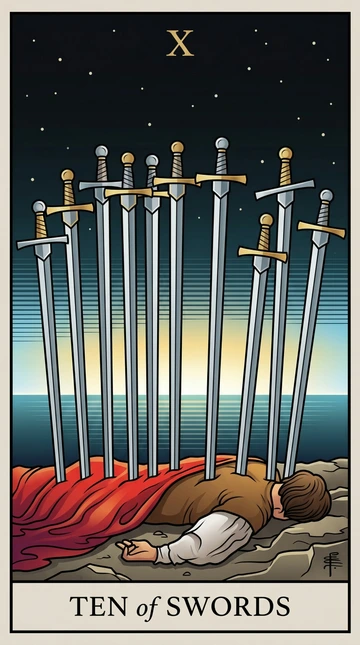
- ✱Do not default to negative. A reversal is not inherently bad. The Ten of Swords reversed, for instance, often signals recovery and the worst being over.
- ✱Let context guide you. The same reversed card can mean different things in different positions and in response to different questions. The question you ask shapes how a reversal speaks.
- ✱Trust your first impression. When a reversed card appears, notice your gut reaction before consulting any guidebook. That initial response is often your intuition speaking clearly.
- ✱**Record reversals in your journal.** Over time, you will develop personal associations with reversed cards that are more useful than any textbook definition.
- ✱Be consistent. Decide before a reading whether you are including reversals, and stick with that choice for the entire session. Mixing approaches mid-reading creates confusion.
Reversals Are a Tool, Not a Rule
The most important thing to remember is that reversals are optional and interpretive. They are one of many tools available to you as a reader. Some readings call for them; others do not. Some readers thrive with them; others prefer the clarity of upright-only readings.
What matters is not whether you use reversals, but whether your readings are thoughtful, honest, and useful. Explore what works for you with a practice reading.