Major Arcana · V
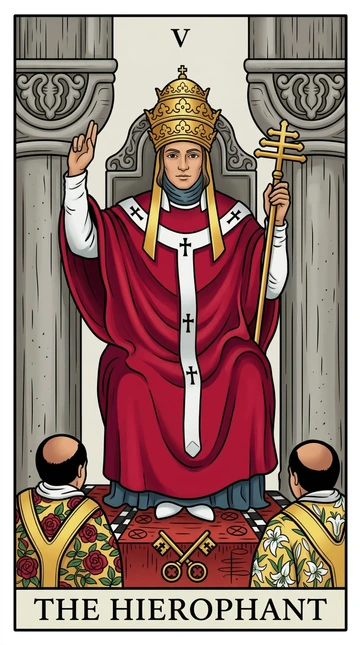
The Hierophant keeps the old knowledge: tradition, teaching, and the tried-and-tested path.
The Hierophant keeps the old knowledge: tradition, teaching, and the tried-and-tested path. He offers the wisdom handed down by those who walked ahead of you. When he appears, there's something to learn from established ways, a mentor, or a set of shared beliefs.
Element
Earth
Planet
♀Venus
Numerology
V, conflict, challenge, disruption, freedom
What the card says to you is truer than what anyone else says it means.
Cards often seen near this one
The Hierophant by life area
He wears the triple crown and is seated between two pillars, but they are not those of the Temple which is guarded by the High Priestess. In his left hand he holds a sceptre terminating in the triple cross, and with his right hand he gives the well-known ecclesiastical sign which is called that of esotericism, distinguishing between the manifest and concealed part of doctrine. It is noticeable in this connexion that the High Priestess makes no sign. At his feet are the crossed keys, and two priestly ministers in albs kneel before him.
He has been usually called the Pope, which is a particular application of the more general office that he symbolizes. He is the ruling power of external religion, as the High Priestess is the prevailing genius of the esoteric, withdrawn power. The proper meanings of this card have suffered woeful admixture from nearly all hands. Grand Orient says truly that the Hierophant is the power of the keys, exoteric orthodox doctrine, and the outer side of the life which leads to the doctrine; but he is certainly not the prince of occult doctrine, as another commentator has suggested.
He is rather the summa totius theologiæ, when it has passed into the utmost rigidity of expression; but he symbolizes also all things that are righteous and sacred on the manifest side. As such, he is the channel of grace belonging to the world of institution as distinct from that of Nature, and he is the leader of salvation for the human race at large. He is the order and the head of the recognized hierarchy, which is the reflection of another and greater hierarchic order; but it may so happen that the pontiff forgets the significance of this his symbolic state and acts as if he contained within his proper measures all that his sign signifies or his symbol seeks to shew forth. He is not, as it has been thought, philosophy-except on the theological side; he is not inspiration; and he is not religion, although he is a mode of its expression.
Source: “The Pictorial Key to the Tarot” by A.E. Waite (1910). Public domain.
Explore the 22 Major Arcana cards, their archetypal meanings, and the story they tell about life's transformative experiences.
Reversed cards are one of the most misunderstood aspects of tarot. Learn what they actually mean, how to interpret them, and whether to include them in your practice.
Learn the fundamentals of reading tarot cards, from forming your question to interpreting the spread.
Learn how the simplest tarot spread can deliver powerful daily insights with just one card.
Self-reading is one of the most rewarding ways to use tarot, but it comes with unique challenges. Learn how to read for yourself with clarity and honesty.
See how The Hierophant speaks to your life right now. Life in Cards weaves your zodiac, past readings, and personal context into every interpretation.
Sign Up FreeA free reading every week, no card required
Or have a card waiting in your inbox each morning. One email a day, unsubscribe any time.